
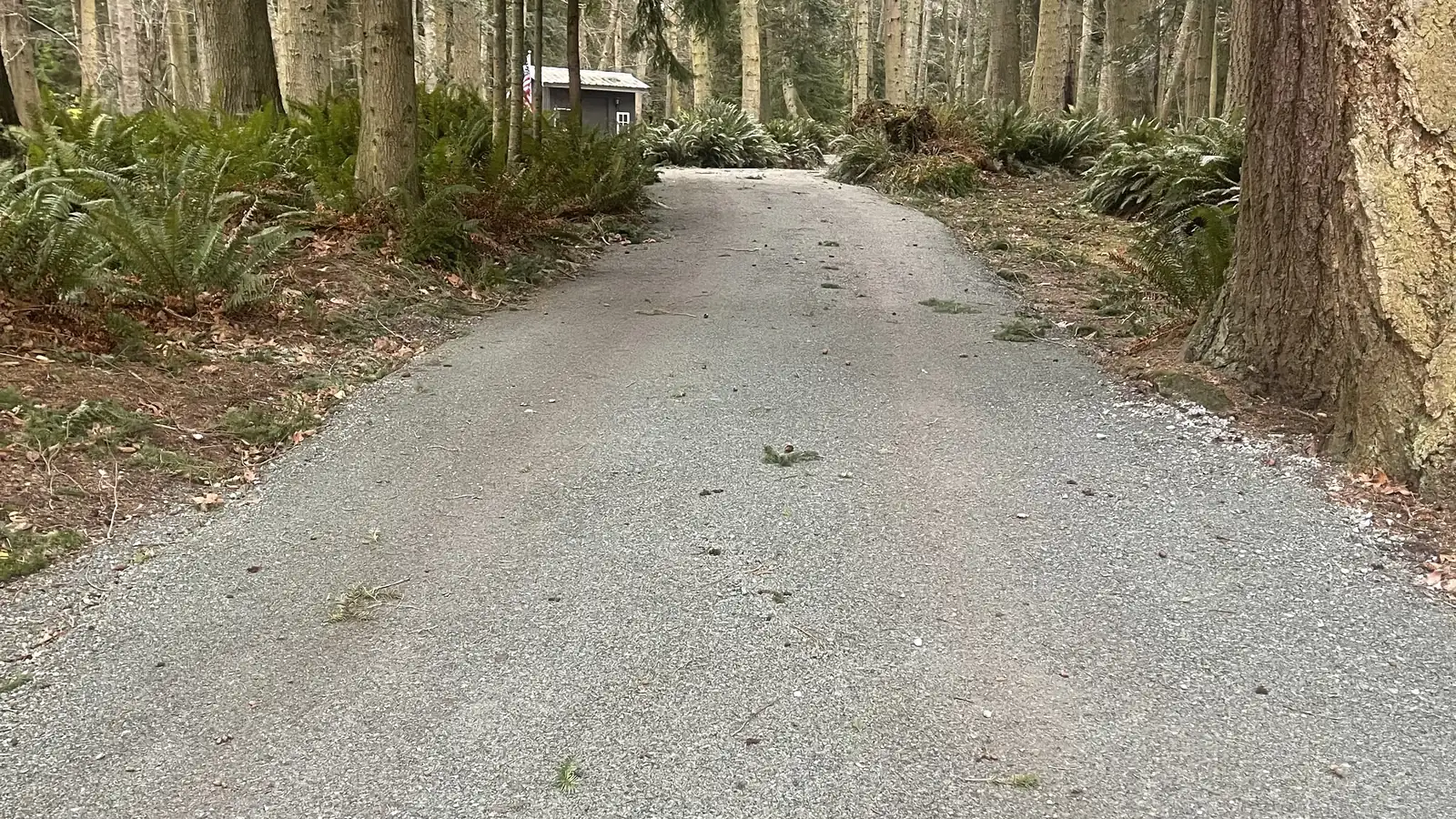
What is the best gravel for a driveway on Whidbey Island?
The best gravel for a driveway on Whidbey Island is crushed rock, built up in layers. Big angular rock goes down where the ground is soft. Crushed base rock goes on that, then a crushed top rock with fines that packs hard. The top gets a crown so rain runs off both sides.
What is the best gravel for a driveway?
A driveway is a stack of layers, and each layer needs its own rock. Quarry spalls, big broken rock with almost no fines, go first where the ground is soft and wet. Crushed base rock such as 1 1/4 minus goes on next, packed in lifts. A finer crushed top rock such as 5/8 minus makes the driving surface.
The top rock carries fines on purpose. Crushed rock with fines, well compacted, fits together tightly and gives vehicles a stable surface. Round gravel does not compact well, so it makes a poor driving surface.
That order is how our crew handles gravel driveway installation and repair on the island. Base rock goes in lifts, crushed rock goes on top, and the surface is crowned to shed water.
Each rock has a job, set by its top size and its fines. The percent figures in the table are WSDOT’s caps on the finest dust in each grade.
| Rock | Top size | Fines | Where it goes in the driveway |
|---|---|---|---|
| Quarry spalls | 8 inch | Almost none | First layer over soft, wet ground |
| Ballast | 2 1/2 inch | Up to 9 percent | A coarse course under finer rock |
| 1 1/4 minus (base course) | 1 1/4 inch | Up to 7.5 percent | The base, in compacted lifts |
| 5/8 minus (top course) | 5/8 inch | Up to 10 percent | The top layer, crowned to shed rain |
Why crushed rock beats rounded gravel
The FHWA gravel roads guide calls road gravel a mix of three sizes: stone, sand and fines. Without a good blend of the three, it says, the gravel performs poorly. The stone should be fractured, and the fines should have a binding quality.
Crushing makes the difference. Fractured stone resists movement under loads better and adds strength. Broken stones also embed into a gravel surface much better than rounded, natural-shaped stone. Crushed pieces interlock with the stones around them, while rounded stone tends to shift and move under loads.
WSDOT writes the same idea into its spec. Its crushed surfacing is made by crushing ledge rock, talus or gravel. Base course and top course both need at least 75 percent fractured stone. A fractured stone has at least one broken face.
Quarry gravels are often very good material, the FHWA guide says, because nearly every piece is fractured. When pit run gravel is crushed, many of the small, natural stones come through without being fractured.
Round gravel usually comes from river deposits, and pea gravel is round gravel with very small rocks. A Forest Service design guide calls round or pea gravel a poor choice for roads and parking areas. The rocks roll against each other.
A vehicle pulling a trailer has trouble getting traction on round gravel. As the gravel rolls, the vehicle can sink and get stuck. Crushed rock, with its angular faces, compacts relatively well.
What do 5/8 minus and 1 1/4 minus mean?
Washington rock yards name crushed rock by its top size and the word minus. One yard lists 5/8 minus and 1 1/4 minus as its most popular driveway gravels.
The number is the largest piece. A 5/8 minus is made up of rock pieces up to 5/8 inch across. The Forest Service guide uses the same naming: its 3/4 inch minus includes rocks about 3/4 inch and smaller.
Minus means everything smaller comes along, down to the fines. Minus rock includes a lot of smaller crushed pieces, and some of it looks like dirt or dust. Those fines help the rock compact. Clean rock has no fines.
WSDOT’s spec book uses its own names. Crushed surfacing base course has a 1 1/4 inch top size. Top course, also used as keystone, has a 3/4 inch top size. Maintenance rock is top course material graded smaller, with a 5/8 inch top size.
The same rock yard ties its local names to these grades. It labels its 1 1/4 minus as crushed surfacing base course. Its 5/8 minus is labeled top course, a grade that runs up to 3/4 inch.
Both carry fines on purpose, within a limit. WSDOT caps the finest dust, the part that passes a No. 200 sieve, at 7.5 percent in base course and 10 percent in top course.
Sizes differ a little between yards. The same yard says a 5/8 minus is not hugely different from a 1/2 inch or 3/4 inch minus.
Quarry spalls and ballast: the rock for soft Whidbey ground
Under the topsoil, much of Whidbey Island is dense glacial till, called hardpan locally, mixed with rock and outwash. Water perches on the till and travels sideways to the low spot. One lot can hold clean sand, till, cobble and groundwater. Winters here are wet, November through March.
Where a driveway crosses soft, wet ground, bigger rock goes down first. The same rock yard gives that order for a road in a really muddy area. Larger clean rock, like quarry spalls, makes a solid foundation. A minus rock goes on top as the driving surface.
Quarry spalls are broken stone. In WSDOT’s spec, all of it passes an 8 inch sieve, and no more than 40 percent passes 3 inches. No more than 10 percent passes 3/4 inch, so spalls are big rock with almost no fines.
Ballast sits between spalls and base rock in size. WSDOT allows it to be crushed, partly crushed or natural. Nearly all of it passes a 2 1/2 inch sieve, and only 50 to 85 percent passes 1 inch. Its finest dust is capped at 9 percent, and top course rock can be keyed into the top of it.
Which rock a soft spot needs depends on how soft it is and where the water runs. We make that call on site, with you, before any rock is chosen.
Is fabric worth it under a gravel driveway?
On weak, wet ground, it is. The FHWA guide says a woven or nonwoven geotextile placed on a weak subgrade becomes a separator. It sits between the weak soil and the new material above it. It keeps very fine, wet silt and clay from pumping up into the rock.
That matters on the island, where water perched on the hardpan can keep a subgrade wet through the winter. Our own photos show the method: crushed rock being spread over fabric on a new gravel driveway. We decide on fabric once we have seen the ground.
How the layers go together
The subgrade comes first: firm ground, shaped to fall and packed. Shaping it is grading and dirt work, and the shape set here guides every layer above it.
Base rock goes on in lifts, each one packed before the next. WSDOT’s rule for gravel base ties lift depth to rock size. The largest stone can be no more than two thirds of the depth of the layer being placed.
The top rock can key into the layer below. When a course needs it, WSDOT uses top course rock as keystone, worked into the gaps of the coarser course. Then the fines, with their binding quality, hold the surface together.
The crown comes last. The FHWA guide recommends a crown rising about 1/2 inch per foot from edge to centerline, about 4 percent. On a driveway 12 feet wide, the center sits about 3 inches above each edge. That stack, from subgrade to crown, is a gravel driveway built in layers.
Gravel now, concrete later?
If you might want concrete someday, say so at the estimate. Our crew also pours a concrete driveway, and the same company does the dirt work under it. Knowing the plan early lets us talk through the base and the slope with you.
How our crew builds a gravel driveway on the island
Our crew is based on the island, out of Langley. We look at the ground and the county maps with you before any work starts.
On a new drive, the work starts with clearing the driveway route and stripping the topsoil. Our excavators dig out soft spots, and the tilt rotator shapes the subgrade to fall. Where the ground is weak, fabric goes down before the rock.
The rock comes from a rock yard, and our crew places it. Base rock goes down in lifts, and the roller compactor attachment on the excavator packs each one. Crushed top rock goes on last, crowned to shed water.
A long private road is its own job, and our page on private road and driveway construction covers it. For a driveway, we put a written price on the work after seeing the ground. The estimate is free.