
How thick should a concrete driveway be on Whidbey Island?
A concrete driveway 4 inches thick carries cars and pickups. Use 5 to 6 inches for delivery or light trucks, and thicker again for regular heavy trucks. The slab is one thickness throughout, so any extra inch goes in at the pour. On island ground, the compacted base under it matters as much.
How thick should a concrete driveway be?
Two state concrete associations publish plain driveway figures. The Virginia Ready Mixed Concrete Association says to pick the thickness by the type of traffic that will use it. For passenger cars and pickups, it says 4 inches. For light trucks it says 5 to 6 inches, and thicker if heavy trucks are to use the site.
The Michigan Concrete Association sets 4 inches as its minimum for a driveway. When traffic will include delivery vehicles, its minimum is 5 inches. The Ohio concrete guideline adds a limit on the other side. Unless heavy trucks will park on it regularly, it says, a thicker pavement is just extra material.
Neither association is local. The Michigan association notes that its state is classified as a severe weathering region, and the Island County table rates ours moderate.
| Use | Thickness | Who says so |
|---|---|---|
| Passenger cars and pickups | 4 inches | Virginia Ready Mixed Concrete Association |
| Any driveway, as a minimum | 4 inches | Michigan Concrete Association |
| Delivery vehicles | 5 inches minimum | Michigan Concrete Association |
| Light trucks | 5 to 6 inches | Virginia Ready Mixed Concrete Association |
| Heavy trucks | Thicker again | Virginia Ready Mixed Concrete Association |
| No heavy trucks parked regularly | Extra thickness is extra material | Ohio concrete guideline |
For concrete driveway installation on the island, we set the thickness with you at the estimate. The number starts with what will drive on the slab, now and later.
Is 4 inches enough, or should you pour 6?
For cars and pickups, 4 inches matches both state guides. The real question is what else will use the driveway, now and later. A delivery truck or a loaded trailer is heavier than the family car. So is a concrete truck or a dump truck coming in for a later build.
The Virginia guide says the concrete should be one uniform thickness throughout the slab. A thicker strip just for truck tires is off the table. If heavier vehicles will cross the driveway, the whole slab is poured to suit them.
Going thicker than you need has a limit. The Ohio guideline calls it an excess of material unless heavy trucks will park on the slab regularly. So the right number comes from the vehicles that will really use it.
The time to decide is before the pour. The Michigan association says the extra inch for truck traffic has to be poured from the start. It cannot be added afterward.
What goes under a concrete driveway on Whidbey Island?
Under the topsoil, much of Whidbey Island is dense glacial till, called hardpan locally, mixed with rock and outwash. Water perches on the till and travels sideways to the low spot. One lot can hold clean sand, till, cobble and groundwater. A driveway cut into that ground can turn into the low spot.
That is why the base matters as much as the inches. We do the dirt work the concrete sits on, then pour the slab on top of it.
Soft spots come out first. The Virginia guide says soft or wet subgrade must be replaced with compacted earth or stone. The Michigan guidelines remove unstable material to at least 6 inches deep. They replace it with compacted crushed stone, gravel or sand.
Then the sub-base goes in. Michigan calls for at least 4 inches of compacted sub-base. No standing water can sit on it when the concrete is placed. In no case does concrete go on a frozen subgrade or sub-base.
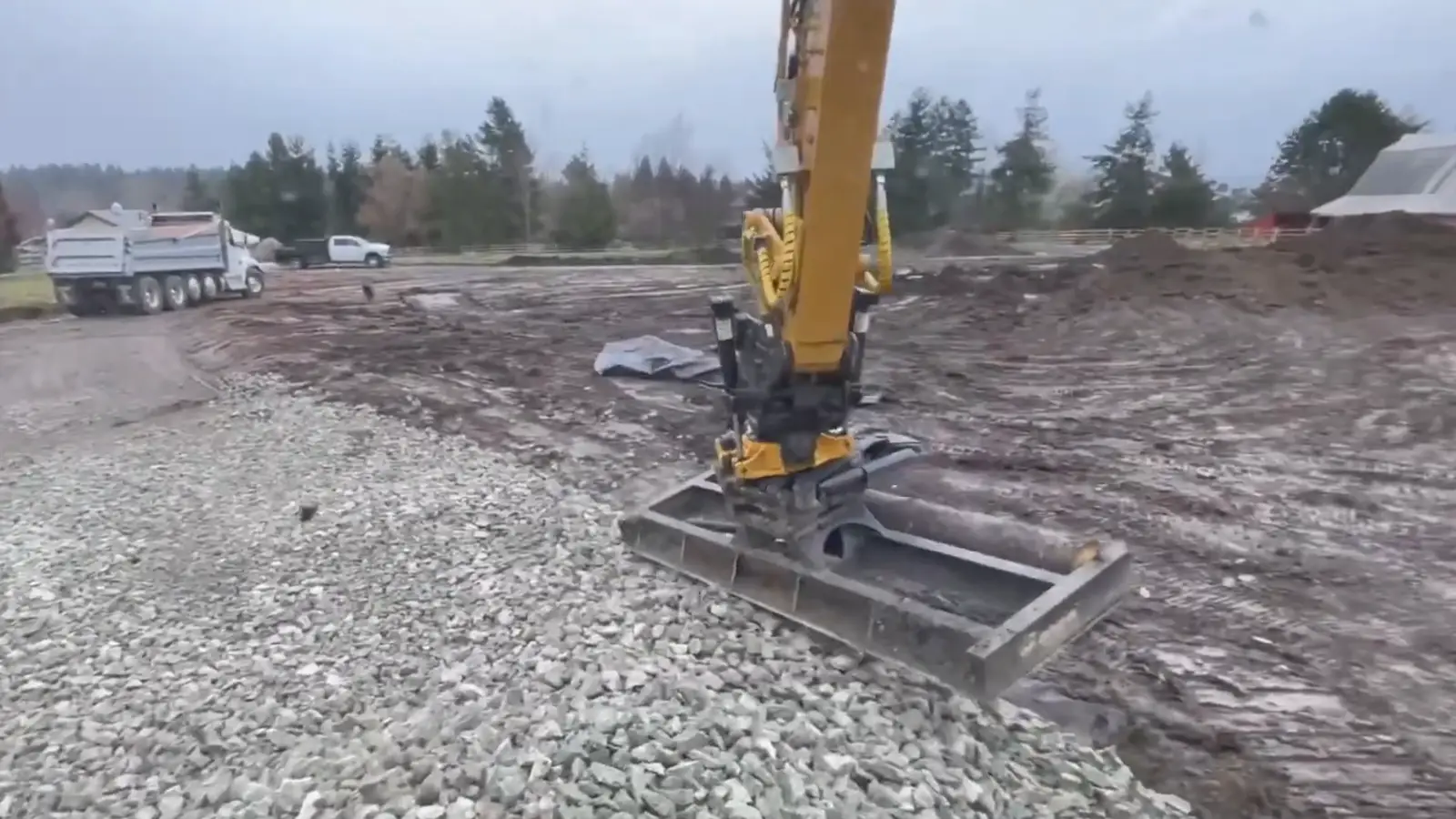
Our excavators cut down to firm ground, and the tilt rotator trims the subgrade to fall. Crushed rock goes down in thin lifts, and the roller compactor attachment on the excavator packs each one. That shaping is grading, and it sets the slope the concrete will follow.
The finished slab needs fall too. The Ohio guideline says it should slope at least 1/8 inch per foot. It says 1/4 inch per foot gives better assurance that water will not pond.
Concrete does not have to run the whole length of a long rural drive. A concrete apron at the garage can meet a crushed rock gravel driveway for the rest of the run.
Rebar, wire mesh or fibers: what does a driveway need?
The Ohio concrete guideline has a short reinforcement rule for residential slabs. It says wire mesh is not necessary in residential slabs. It says synthetic fibers may be used to control early-age cracking.
That line speaks to mesh and fibers. It does not rule on rebar, and the Virginia and Michigan guides cited here set no steel rule. What goes into your slab is a call for the job, and the estimate spells it out.
Joints do the crack control. NRMCA, the national ready mixed concrete group, says cracks cannot be prevented entirely. Properly designed joints control them and keep them small. In its words, joints are simply pre-planned cracks.
Tooled joints are run early in the finishing process. The panels between joints should be square or nearly so. On spacing, the guides differ. NRMCA puts joints about 10 feet apart in a 4-inch slab and caps spacing at 15 feet.
Michigan runs joints both ways at no more than two feet for each inch of thickness. That works out to 8 feet for a 4-inch slab.
Isolation joints separate a driveway from sidewalks, garage slabs and stairs. Where the drive meets the garage, one sits between the two slabs. We also pour foundations, footings and garage slabs, so both sides of that joint can be planned together.
What strength and air does Island County weather call for?
Island County fills in the state’s design criteria table for home building. That table rates the county’s weathering as moderate. Washington has adopted the 2021 International Residential Code, which sets concrete strength by weathering.
The code does not list driveways. Its nearest line, in Table R402.2, covers porches, carport slabs and steps exposed to the weather, and garage floor slabs. Where weathering is moderate, those slabs need at least 3,000 psi, a strength rating in pounds per square inch.
Treat that as the closest code line to a driveway. It is written for those slabs.
The same table covers air. The code says concrete facing moderate or severe weathering is air entrained, as the table specifies. A table note puts the total air at 5 to 7 percent by volume.
NRMCA says concrete exposed to cycles of freezing and thawing should be air-entrained. Ask what strength and air the mix for your driveway will carry.
How long before you can drive on a new concrete driveway?
A Virginia association specification keeps new pavement closed to passenger cars for at least three full days. For at least seven days after placing, it allows only passenger cars and light trucks. Heavier trucks wait longer than that.
The wait protects the cure. NRMCA says curing starts right after finishing and typically runs 3 to 7 days. Proper curing reduces crazing, dusting and scaling of the surface. Concrete left in a dry environment can lose as much as 50 percent of its potential strength.
Cold weather changes the plan, and NRMCA defines it by the daily average. When that stays under 40 degrees F for more than 3 days in a row, special precautions apply. In its fresh state, concrete freezes below about 25 degrees F. It is protected from freezing until it reaches 500 psi, about two days after placement.
Winters here are wet, November through March, so we schedule each pour between storms. We watch the forecast for cold. We tell you when the driveway can take a car.
Where the driveway meets the county road
Where a new driveway meets a county road, the county Access Permit applies. It covers installing a new driveway entrance, relocating an entrance or permitting an existing one. The property owner applies, or an agent the owner names on the form.
The approval covers the county right-of-way only, and other permits may be required. One condition the county can mark sends stormwater review to a building permit or land-use application.
The county can attach conditions to the permit. One is a call to the road supervisor before asphalting or concreting the driveway. Another keeps the driveway at least 5 feet from the property line. A third is a 20-foot flat landing at the road, no steeper than 2 percent unless approved in advance.
These county rules cover unincorporated Island County. Inside Oak Harbor, Coupeville or Langley, ask the city or town.
We look at the ground and the county maps with you and tell you which rules the job touches. Then we build to the conditions written on the permit. Longer approaches have their own page, which covers long private roads and culvert crossings.
The estimate comes after we see the ground with you. It is free.