
Do you need to call 811 before you dig on Whidbey Island?
Yes, almost always. Washington’s dig law covers anyone who moves earth by any means, homeowners on Whidbey Island included. Mark the dig area in white, then call 811 or file online at least two full business days ahead. The request is free, and the utilities mark their buried lines before you dig.
Do you have to call 811 before digging in Washington?
Yes. Washington’s dig law, RCW 19.122, covers any excavation. That means any work that moves earth, rock or other material on or below the ground, by any means. Even putting in a sign counts.
The law calls anyone who digs an excavator, and that covers individuals too. So the rules apply to a homeowner with a shovel the same as a contractor with a machine.
The steps come in a set order. First, mark the boundary of the dig area with white paint or white pin flags. Then notify every utility through 811, the one-number locator service, with your start date.
The state Utilities and Transportation Commission puts it simply. Call 811 before you dig and request a free underground utility locate. The law is the same in Oak Harbor, Coupeville and Langley as in the rest of Island County.
When we do utility trenching for water and power lines, the locate request goes in before any digging. The law puts the notice on whoever does the digging, so on our jobs we file it.
When can you dig without calling 811?
The one exemption a homeowner usually meets is shallow digging. Digging less than 12 inches deep on private noncommercial property skips the white lining and the notice. It applies only when the person who owns or lives on the property does the digging, or their employee.
Both parts have to fit. A shallow flower bed you dig yourself can qualify. A trench 12 inches deep or more does not, and neither does a dig on commercial property.
The other exemption is an emergency. An emergency dig skips only the white lining and the advance notice. The notice still goes in at the earliest chance. If you are not sure your situation counts, ask the 811 center.
Every other dig gets the white lining and the notice. On our jobs, we file a locate request for every dig, shallow or deep.
How do you file a locate request?
You can call 811 or file online, and the request is free. State law requires the online system to be free for anyone asking for a locate. Utilities may not charge a fee to mark their own lines, with a few narrow exceptions in the law. A homeowner or one-time digger can file a single request online with just an email address.
Mark the dig area in white before you file. The ticket then asks where and when you plan to dig:
- the dig site, shown on a map
- the distance from the nearest cross street
- any overhead power lines near the work
- rights-of-way and easements
- the work you plan and your start date
A wooded lot with no house yet may have no street address. In that case, the ticket describes the site by township, range, section and quarter-section.
Time the ticket to your start date. It goes in at least two full business days before work begins, and no more than 10. Business days skip Saturdays, Sundays and legal holidays.
File on a Friday, and Monday and Tuesday are the two full business days. Wednesday is the earliest start. If a holiday falls in that window, ask the 811 center. Keep the ticket number, since it is your proof that you called.
What happens after you call, and how long do the marks last?
811 sends your ticket to its member utilities in the area. They have two business days to locate and mark, not counting the day of notice, weekends or holidays.
Since January 1, 2026, you may not start digging until every utility in the notice area sends a positive response. Paint from one utility does not clear the dig. If a response is missing on your ticket, ask the 811 center before you start.
The marks follow the American Public Works Association color code. Letters on each mark give the type of line, its best known width and the company that runs it.
Marks expire 45 calendar days after the date you gave notice. The clock starts the day you file, so it is already running when the paint goes down. Work after that date needs a new ticket.
On the island, wet winters run from November through March. A trenching job that waits out a stretch of rain can outlast its marks. Then a new ticket goes in before digging starts again.
What 811 will not mark on a rural Whidbey property
811 brings out the utilities, and each one marks the lines it owns. The state warns that some buried lines in your work area may not be utility owned. Its list includes power to an outbuilding, invisible fences, fiber optic lines and septic systems. Pool heating lines and satellite dish lines are on it too.
Washington law makes the property owner responsible for locating the lines they own on their own property. So private utility locating on your land is up to you. The 811 center keeps a list of private locators you can hire at your own cost.
On a rural Whidbey parcel, the utilities will not mark lines you own. Power run to a shop or barn is one example. A drain is another, such as a footing drain or yard drain line.
Start with what you know about where your own lines run. Then use a private locator or careful test digging before a machine works near them.
Some lines cannot be marked with reasonable accuracy at all. The law’s examples are service laterals, storm drains and nonmetal lines with no trace wire. If one may cross your dig, ask the utility what it knows.
| Kind of line | Who marks or finds it |
|---|---|
| Lines a utility owns | The utility, after your 811 ticket |
| Power to a shop or barn, or a water line from your own well | You, or a private locator you hire |
| Septic system, invisible fence or satellite dish line | You, or a private locator you hire |
| Lines that cannot be marked accurately | Ask the utility, then find them with small test holes |
How close can you dig to a marked line?
A mark counts as reasonably accurate when it is within 24 inches of either outside edge of the line. So the edge of the real line can sit up to 24 inches to either side of the mark.
Washington law makes the digger find the precise location of each marked line. It also requires reasonable care to avoid damaging buried lines.
The law lists careful methods, including potholing, also called daylighting. That means a series of small test holes dug to find exactly where the line runs. Digging by hand is on the list too, when practical.
Once the line is in sight, a machine can work close with care. Under the topsoil, much of the island is dense glacial till, called hardpan locally, mixed with rock. Test holes through it by hand take time, and we plan the schedule for that.
What if you find or hit a line that was not marked?
Stop digging near it, and notify the utility through 811 right away. That is what Washington law requires when a dig turns up a line nobody marked.
If you hit a line, notify the utility and 811. If the damage causes an emergency, call 911 as well. Do not bury a damaged line. It stays uncovered until it is repaired or relocated.
An unmarked line may be a private line, which no utility marks. It may also be a line the utility could not mark with reasonable accuracy. For anything past these steps, ask the utility or the 811 center.
How our crew handles locates on a trenching job
Our locate steps run in the same order on every job. We mark the dig area in white and file the locate request ahead of the start date. Then we wait for every positive response before a bucket goes in.
We also ask where your private lines run, like power to a shop or a line from your well. We find those before a machine works near them. Inside 24 inches of any mark, we dig with care until the line is in sight.
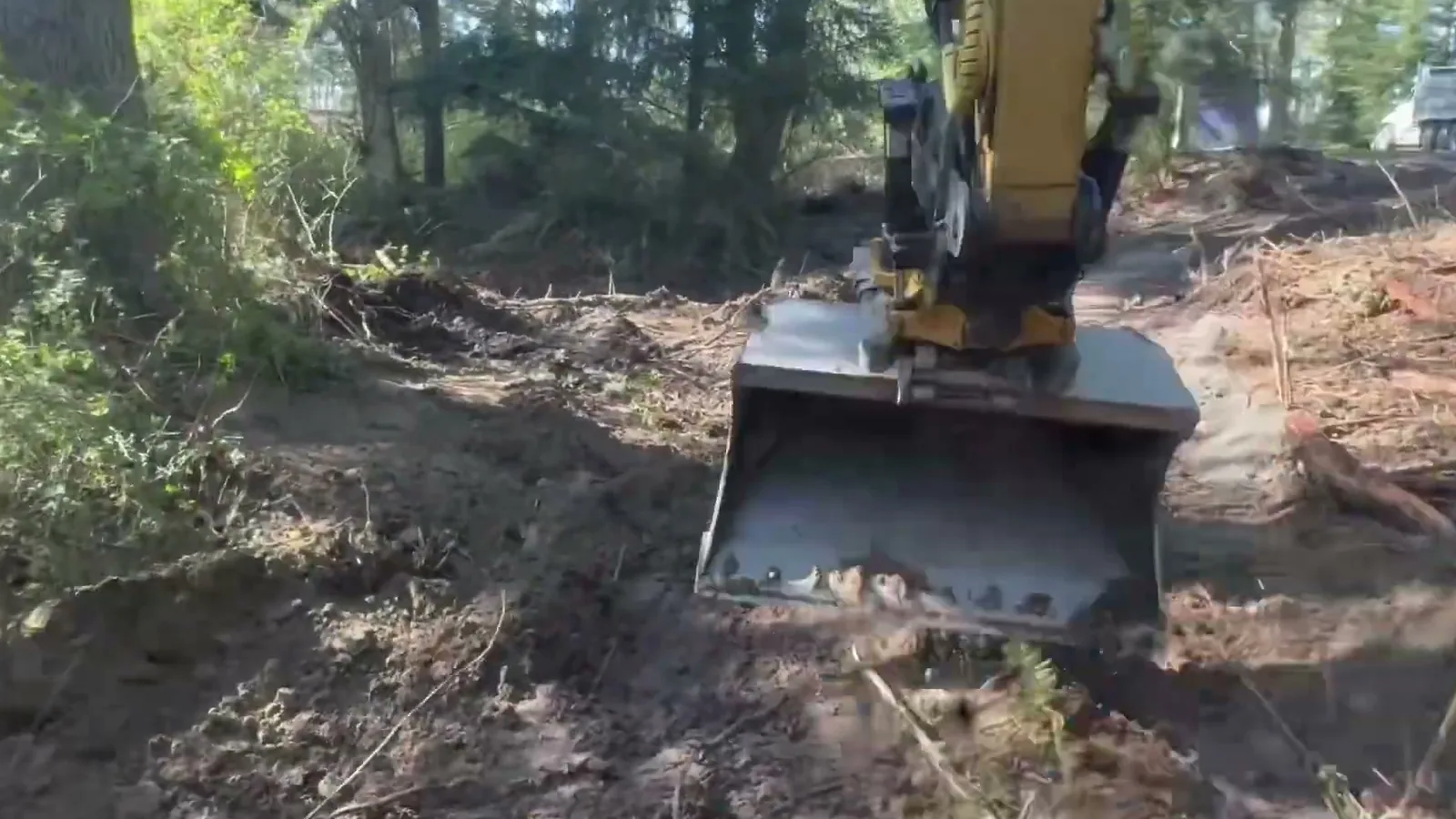
Then the trench goes in. Our excavators handle the digging, and the CAT 306 mini excavator fits the tighter spots. The tilt rotator tilts and turns the bucket, so it can work beside an exposed line.
Backfill goes back in thin lifts, and the roller compactor attachment on the excavator packs each one. That is how we handle trenching a new water or power line. The same locate steps come first on excavation for a new house site. They also come first on a new driveway or private road.