
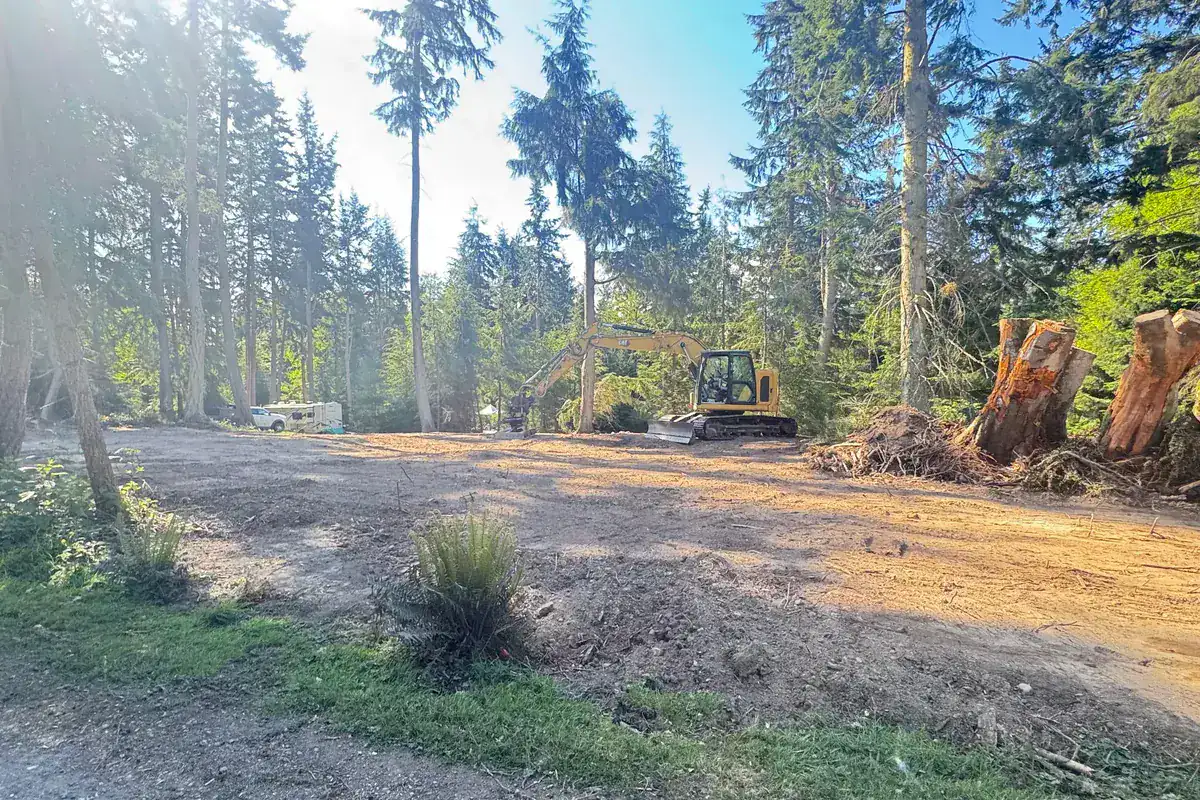
Do you need a permit to clear land on Whidbey Island?
In unincorporated Island County, clearing brush and small trees on flat ground away from water usually needs no permit. A county grading permit starts past 500 cubic yards of cut and fill, or past two acres to bare earth. It applies in any quantity near the shoreline, on a steep slope, or in a critical area.
Cutting timber to open a house site is a second question. That harvest is usually a Class IV forest practice, and the application goes to the state Department of Natural Resources.
Oak Harbor, Coupeville and Langley are cities with their own codes. Everything else on Whidbey and Camano is unincorporated Island County, which is the ground covered below.
When does Island County require a clearing and grading permit?
Island County Code 11.02 is the clearing and grading chapter. A grading permit shall be required for all land disturbing activities, unless exempted by this chapter. Clearing means the cutting and removal of vegetation by mechanical or chemical methods.
Four situations pull a job into the permit.
| What triggers the permit | What that means on your property |
|---|---|
| Filling or excavation adding up to more than 500 cubic yards | Cut and fill get added up across the job |
| Any quantity within 200 feet of a regulated shoreline, on a steep slope, in a geologically hazardous area, or in wetlands or their buffers | Volume stops mattering on this ground |
| A Class IV forest practice permit or a conversion option harvest plan | The county counts a state conversion harvest as land disturbing activity |
| Clearing to bare earth greater than two acres | A big cleared opening needs the permit on its own |
Administration and interpretation of the chapter sit with the Planning and Community Development Director. That office decides borderline cases.
We do land clearing across Whidbey Island and Camano Island. The permit question is the first thing we check on a new parcel. We read the county maps with you and name the triggers your job hits.
What clearing is exempt from the county permit?
Section 11.02.090 holds the exemptions, and the doorway is narrow. The work has to sit outside a critical area and its associated buffer. It also has to be at least five feet from the property boundary line. Nothing partially or entirely within a geologically hazardous area or steep slope is exempt.
Inside that doorway, these exemptions come up on clearing jobs.
- Accumulated filling and excavation of less than 500 cubic yards. One condition rides on it: the grading the code lists there, such as work that leaves an existing drainage course alone or creates 5,000 square feet or less of new impervious surface, still has to meet the chapter 11.03 erosion and sediment control minimums.
- Grading on a site for a single family dwelling and accessory structures. Excess material goes to a permitted site approved by the director. The excavation waits for the building permit.
- Site investigative work for a land use application: surveys, soil borings, test pits and soil logs.
- Grading of 5,000 cubic yards or less in an isolated, self-contained area outside a UGA or RAID, with no danger of environmental degradation to critical areas.
One line in the critical areas chapter governs all of it: an exemption from having to obtain a permit is not an exemption from compliance.
Brush is usually the easy case. On flat ground away from water, pulling blackberry and Scotch broom without taking the trees stays under the permit line.
Do you need a permit to cut trees on Whidbey Island?
Trees run on a separate track, the state Forest Practices Act.
Cutting or removing less than five thousand board feet of timber for personal use is a Class I forest practice. No application. DNR puts 5,000 board feet at roughly one log truck load in a year.
Forest practices on lands that are being converted to another use are Class IV. Taking timber off a lot to open a house site or a pasture is a conversion. A conversion takes an application.
Five Western Washington counties took conversion permits over from the state: Clark, King, Mason, Pierce and Thurston. Island County is not among them. In other areas, you need an FPA/N and a SEPA checklist. So a conversion here files with DNR, which has 30 calendar days to approve, conditionally approve or disapprove it.
The form asks whether you are converting any portion of the land to non-forestry use within three years. It spells out the stakes for a landowner who says no and then converts anyway: the county or city may deny development permits for six years.
State law puts it in harder words. Harvest under an application that did not declare a conversion, then convert within six years of approval. State law calls that a violation, unless the county, city or town consents. A landowner who changes their mind inside six years has to stop all forest practices activities. Then comes the conversion process.
Island County ties the two together. Its code counts a Class IV forest practice permit as a land disturbing activity. The county grading permit rides along.
What about bluffs, steep slopes, wetlands and other critical areas?
This is the part that catches waterfront and bank property.
A steep slope means ground forty percent or steeper within a vertical elevation change of at least ten feet. A geologically hazardous area is land mapped for slide activity or unstable slopes. The map is the Department of Ecology Coastal Zone Atlas dated April 1979. The hazard area takes in those lands within 100 feet of either the top or the base.
Distance decides whether a geotechnical report comes into it. Fifty feet or greater clears a slope 10 to 30 feet high. Seventy five feet clears a slope 30 to 50 feet high. One hundred feet clears a slope over 50 feet.
Inside a geologically hazardous area there is no setback to stand on. All grading there requires a geotechnical engineering report, an engineered grading plan and a full drainage plan.
Wetlands and streams add a layer. You submit a completed Field Indicators Worksheet even if no critical areas are known on your property. Not all wetlands and streams are mapped by Island County.
If critical areas are mapped on or near your property, you will need to contact a qualified environmental consultant. Environmental review is required for development in the vicinity of critical areas, and that can mean a SEPA checklist. The county’s other critical areas are fish and wildlife habitat conservation areas, frequently flooded areas and critical aquifer recharge areas.
Trees count in these areas too. Under the critical areas code, removing or harvesting trees or other vegetation is an alteration. That holds inside a wetland, a habitat area or a buffer. It is regulated work rather than yard cleanup.
On a parcel carrying any of this, planning the whole site before the first machine arrives saves the most. Where the pad and the driveway go decides how much regulated ground the job touches.
What happens if you clear without a permit?
Island County Code 11.02.020 is short about it. Failure to comply is subject to the enforcement and penalty provisions stated in the chapter. That covers land disturbing activity done without the required permit.
The forest practices side carries a longer tail. Harvest under a no conversion application, then convert inside six years without the county’s consent. State law calls that a violation. The county or city may deny development permits on the parcel for six years. That is a long time to own a cleared lot you cannot build on.
How does the permit question fit into a clearing job?
Before anything moves, we look at the ground with you and pull up the county critical areas map. Then we say which triggers the job hits.
The application is yours to sign. The code defines the applicant as the property owner, or a person the owner names in writing. We help with the site plan and the clearing limits. We do not give legal advice.
Bigger jobs carry one more piece of paper. A grading permit application over 500 cubic yards comes with public notice signs, posted within five working days of filing.
Then the work runs in order. Utility locates go first. Washington sets the notice window at not less than two full business days before the scheduled work to begin date. Those are the same lines we locate when trenching for water, power and septic lines. Then comes the clearing corridor, the debris haul off or chipping, and cut and fill grading after the clearing.
That sequence is lot and acreage clearing with our excavators. The same company does the clearing, the dirt work and what comes after.
Where to ask in Island County
Island County Planning and Community Development runs the clearing and grading chapter. The Whidbey counter is at 1 NE 6th Street in Coupeville. A second office sits at 121 N East Camano Drive on Camano Island. Planners take questions by appointment only on Wednesdays.
The county charges a fee, and it varies by permit type. Its adopted schedule lists clearing and grading permits as Type I, Type II and Type III, plus drainage review. The current schedule is on the county website.
Inside Oak Harbor, Coupeville and Langley city limits, the city handles the permit. Everywhere else, a question about a bluff, a wet corner or a property line goes to the county first.